Lesson 14 — The Fovea and the Frame: How We Actually See
How we see in photography is not the same as how a camera records light. Human vision is selective, directional, and constantly moving. Understanding the fovea—the eye’s point of sharpest focus— changes how you compose, frame, and guide attention.
Learning Objectives
- Understand how we see in photography versus how cameras record scenes.
- Explain the role of the fovea in visual attention.
- Recognize how peripheral vision shapes composition.
- Apply perceptual awareness to framing and subject placement.
1) How We See in Photography Is Not Neutral
How we see in photography begins with biology. Unlike a camera sensor, the human eye does not record everything at equal sharpness. Instead, vision is built from constant micro-movements. Your eyes scan, pause, and re-scan—assembling a mental image from many focused glances.
2) The Fovea — Where Sharp Vision Lives
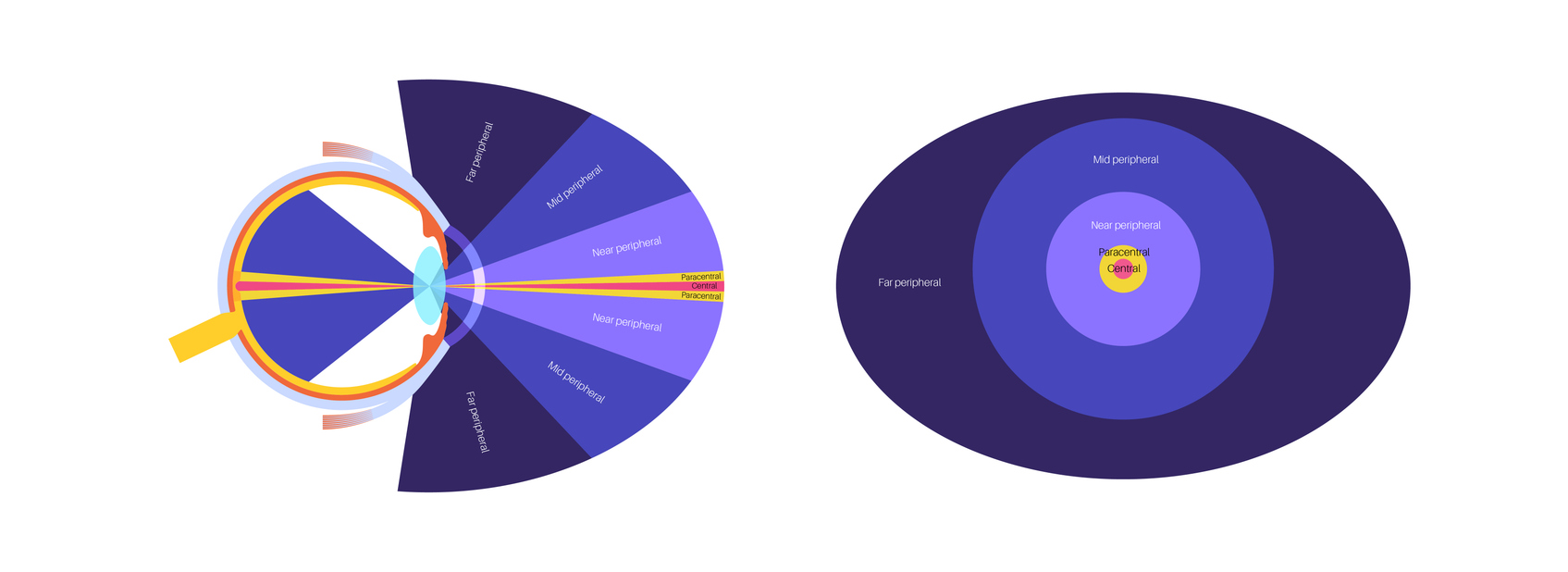
The fovea is a tiny region near the center of the retina responsible for high-resolution vision and color discrimination. Only a small portion of what you see is truly sharp at any moment. Everything else exists in softer awareness. As a result, attention—not detail—defines perception.
3) Peripheral Vision and Context
Peripheral vision detects motion, contrast, and spatial relationships. Although it lacks detail, it provides context. In photography, this explains why edges of the frame matter. Even when they are not sharply examined, they influence mood and balance.
4) The Frame as a Substitute for Eye Movement
A photograph freezes vision into a single rectangle. Because viewers cannot move their eyes freely within time, composition must guide attention deliberately. Therefore, strong compositions mimic how the eye naturally explores: leading lines, contrast, and focal placement act as visual invitations.
5) Why Central Placement Often Feels Powerful
Because the fovea is centered, viewers instinctively seek a focal anchor. Central or near-central subjects often feel stable, calm, or iconic. However, off-center placement can create tension, forcing the eye to travel and explore.
6) Practical Composition Implications
- Place your main subject where the eye naturally settles.
- Use contrast to attract foveal attention.
- Simplify edges to reduce peripheral distraction.
- Allow negative space to support, not compete.
In practice, composition becomes an act of empathy: you are guiding another person’s visual experience.
Hands-On: Mapping Visual Attention
- Choose one photograph you admire.
- Trace where your eye goes first, second, and third.
- Identify what controls that movement.
This exercise reveals how we see in photography—through attention, not detail.
Quick Check (3 Questions)
- What role does the fovea play in visual perception?
- Why does peripheral vision still matter in photographs?
- How can composition guide attention without motion?
Glossary
- Fovea
- The central retinal region responsible for sharp vision.
- Peripheral Vision
- Lower-resolution vision that provides spatial context.
- Visual Attention
- The process of selecting where to focus.
- Composition
- The arrangement of visual elements to guide perception.
Continue in Learn → View all Learn lessons
Jump to: Learn Envision Create
References
- National Eye Institute — How the Eyes Work
- Associated blog(s): Learn — Lesson 13: Practical Exercise (Purposeful Light)
- Associated blog(s): Learn — Lesson 6: The Physics of Vision (Contrast)