Lesson 3 — Lenses & Focal Length: Bending Light to Focus an Image
Light travels in straight lines—until it meets a curve. In lens focal length photography, the camera’s optics bend those paths into a sharp point, turning chaos into coherence. Ultimately, understanding lenses is understanding how the eye, the camera, and creative vision meet on a single plane.
Learning Objectives
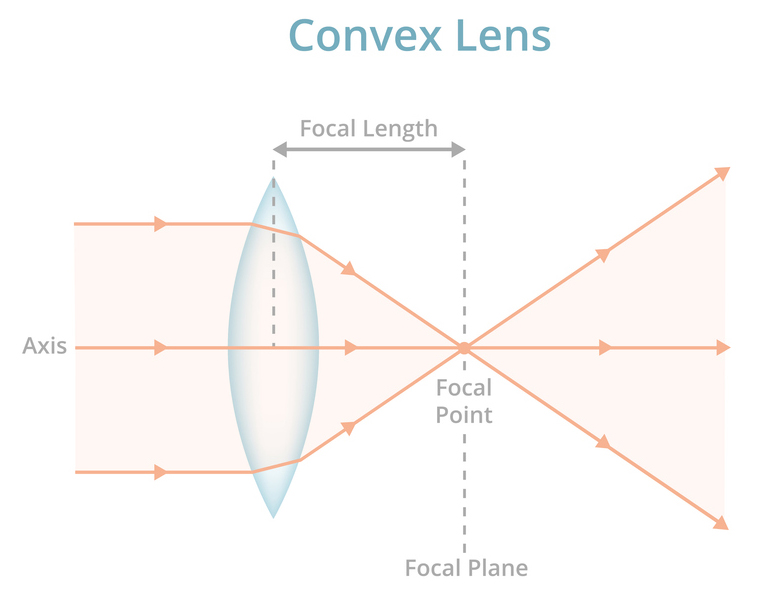
- Describe how convex lenses bend light to form a focused image.
- Define focal length and its effect on field of view and perspective.
- Understand how aperture interacts with focal length to control depth of field.
- Experiment with simple optics to observe how focus changes with distance.
From Pinholes to Polished Glass
Replace a pinhole with a curved piece of glass, and suddenly, more light can enter—yet still be focused. This is the essence of the convex lens: it gathers light and bends (refracts) rays so they converge onto a single plane.
Focal Length in Photography: Field of View and Feeling
The focal length of a lens is the distance (in millimeters) between its optical center and the image plane when focused at infinity. In practice, focal length shapes field of view and the emotional feel of perspective.
The Lens Equation: When Science Meets Practice
1/f = 1/u + 1/v
Additionally, Nikon’s practical explanation is a great complement: Nikon — What is focal length?
Depth of Field: Aperture Meets Focal Length
Depth of field depends on aperture, focal length, and subject distance. Therefore, when you understand the interaction, exposure becomes expressive rather than mechanical.
Aberrations, Coatings, and Character
Modern coatings reduce flare; optical design manages aberrations. Yet many photographers still embrace character—because “perfect” is not always the goal.
Practical Application: Choosing the Right Lens
Moreover, see how focal length choices play out in finished work in the Symmetry in Serenity Gallery .
Hands-On: A Simple Lens Experiment
- Hold a magnifying glass a few inches from a white card facing a bright window.
- Move lens and card until the scene snaps into focus.
- Measure lens-to-card distance—roughly the focal length.
Quick Check
- How does focal length influence field of view and perspective?
- What three factors determine depth of field?
- Why might a photographer choose a vintage lens over a modern one?
Glossary
- Convex Lens
- A lens that converges light rays to form a real image.
- Focal Length
- Distance between optical center and image plane at infinity focus.
- Depth of Field
- The range within which objects appear acceptably sharp.
- Aberration
- Optical imperfection causing blur, fringing, or distortion.
- Aperture
- Adjustable opening controlling light entry and depth of field.
Continue in Learn → View all Learn lessons
References
- Britannica — Focal length
- Nikon — What is focal length?
- Associated blog(s): Learn — Lesson 4: The Exposure Triangle
- Associated blog(s): Envision — The Creative Eye: Seeing as an Act of Being