Lesson 4 — The Exposure Triangle: Balancing ISO, Aperture, and Shutter Speed
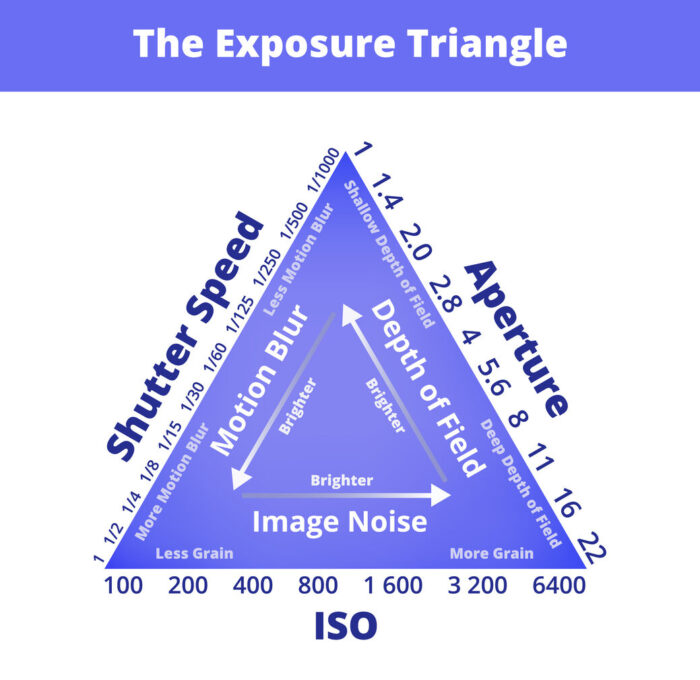
Every photograph begins with light—but it’s your choices that decide how that light becomes an image. The exposure triangle photography framework is the foundation of camera control, blending physics, craft, and expression. Master these three variables, and you master the look of your work.
Learning Objectives
- Define exposure and describe how ISO, aperture, and shutter speed interact.
- Understand stops of light and the concept of reciprocity.
- Recognize the creative effects each variable contributes to your photograph.
- Apply manual and semi-automatic modes effectively to achieve desired results.
What Is Exposure?
Exposure is the total amount of light that reaches your camera’s sensor (or film). It’s determined by three adjustable parameters—ISO, aperture, and shutter speed.
ISO: Sensitivity to Light
Moreover, the Nikon D850’s native ISO 64 is exceptionally clean—one reason it excels for fine-art landscapes.
Aperture: The Gateway of Light
Aperture shapes both brightness and depth of field. It is your brush: it paints focus and guides attention.
Shutter Speed: Capturing Motion and Time
Shutter speed shapes time. Long exposures can transform chaos into tranquility; short exposures slice reality into crisp instants.
The Balancing Act: Reciprocity
f/4 at 1/250 sec, ISO 100 → same brightness as f/2.8 at 1/500 sec, ISO 100
Additionally, Nikon’s practical primer is a helpful complement: Nikon — Understanding Exposure .
Exposure Modes and Metering
Therefore, learning when to apply exposure compensation (+/− EV) is a major step toward intentional results.
Hands-On: The Exposure Triangle in Action
- Open aperture to f/2.8 and double shutter speed; note similar brightness but shallower depth.
- Close aperture to f/11 and slow shutter; note depth and possible motion blur.
- Raise ISO to regain shutter speed; note noise texture change.
Beyond the Numbers: Exposure as Expression
At that point, the exposure triangle photography framework becomes less like a checklist and more like a creative compass.
Quick Check
- What happens if you double ISO without changing aperture or shutter?
- How does a small aperture affect exposure and depth of field?
- Why might two equally bright photos feel emotionally different?
Glossary
- Exposure
- Total light reaching the sensor; controlled by ISO, aperture, and shutter speed.
- Stop
- A doubling or halving of light intensity.
- Reciprocity
- Balancing exposure variables to maintain brightness while changing character.
- Depth of Field
- Range within a scene that appears acceptably sharp.
- Noise
- Digital grain introduced by signal amplification at higher ISO values.
Continue in Learn → View all Learn lessons