Lesson 44 — Atmosphere in Photography: Making the Air Part of the Image
Atmosphere in photography begins when the air between camera and subject becomes an active part of the image.
1) Atmosphere in Photography Is More Than Weather
Fog, mist, rain, snow, haze, dust, humidity, and smoke are often described simply as weather conditions. Yet in photography, they can become visual materials.
Atmosphere changes how light travels, how distant objects appear, how colors are perceived, and how forms separate from one another. As a result, the same landscape can feel entirely different under clear air, thin haze, heavy mist, or falling snow.
Therefore, atmosphere in photography is not merely a record of conditions. It is the deliberate use of those conditions to shape the image.
2) Photographic Atmosphere Changes Depth
Clear air tends to preserve contrast and detail across distance. Haze and mist do the opposite.
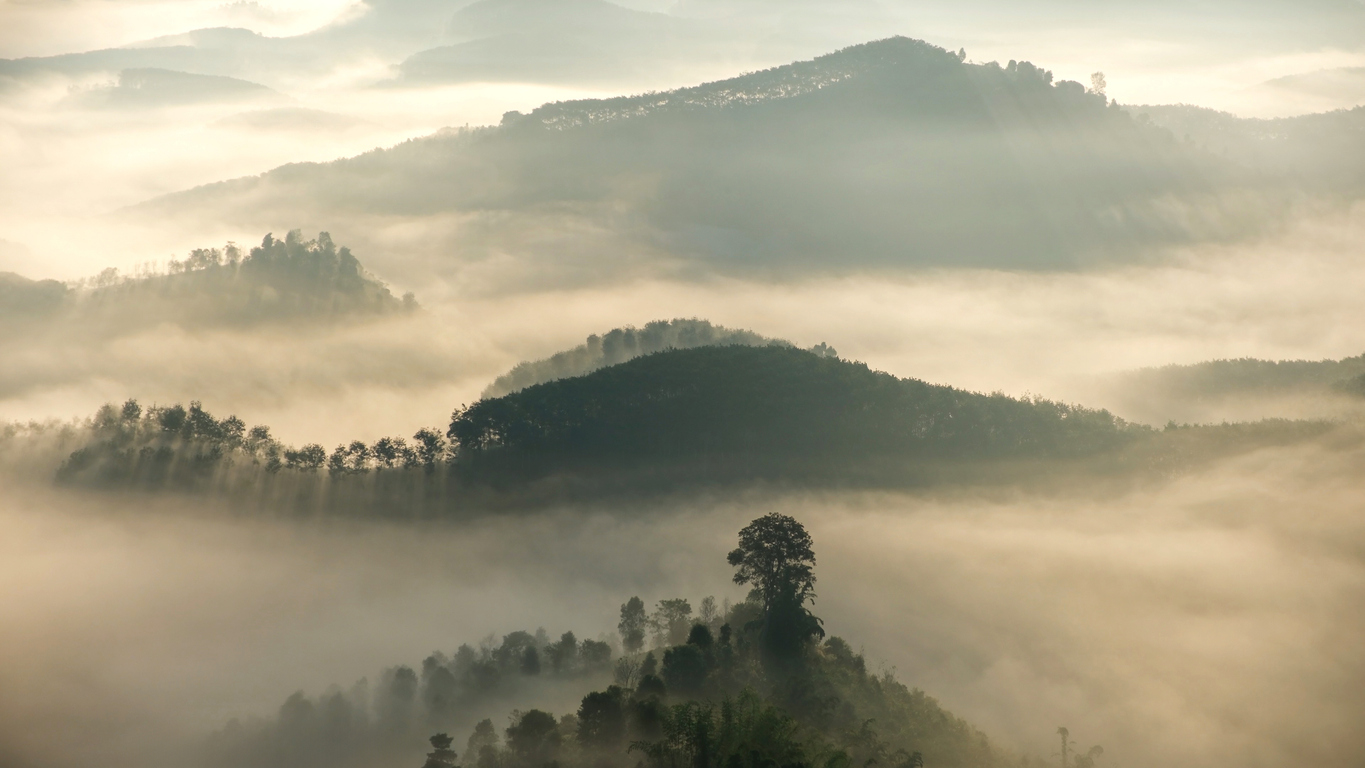
As suspended moisture or particles accumulate between camera and subject, distant forms become lighter, softer, and less distinct. This creates what is often called atmospheric or aerial perspective.
Consequently, layers that might otherwise collapse together can separate naturally. A ridge in the foreground remains dark and defined, while successive ridges fade progressively into the distance.
In this way, photographic atmosphere can create depth without relying on strong lines or obvious foreground elements.
3) Fog and Mist Simplify the Frame
Fog is one of photography’s most effective simplifying tools.
Busy backgrounds disappear. Distracting details soften. Distant objects lose contrast. A complicated scene can become reduced to only a few essential shapes.
This simplification can be especially valuable in forests, city streets, mountain landscapes, and waterfront scenes where visual clutter might otherwise compete with the subject.
However, the goal is not simply to photograph fog. The more important question is what the fog allows the photograph to become.
4) Diffused Light Changes Emotional Tone
Direct sunlight creates crisp shadows, strong local contrast, and clearly defined forms. Diffused light behaves differently.
Clouds, mist, rain, snow, and haze scatter light across the scene. Shadows soften, highlights become less aggressive, and transitions between tones become more gradual.
As a result, photographs made under diffused light often feel quieter and more contemplative. Texture may remain visible, but the image becomes less dependent on dramatic contrast.
This quality is one reason atmospheric photography can feel emotionally restrained even when the subject itself is dramatic.
5) Backlight Makes Atmosphere Visible
Atmospheric particles become especially visible when illuminated from behind or from the side.
Backlight can make mist glow, reveal falling rain, separate snowflakes from a dark background, or turn dust into luminous structure. Light that might otherwise pass unnoticed suddenly becomes visible because particles in the air scatter it toward the camera.
Therefore, when atmospheric conditions appear, consider not only the subject but also the direction of the light. A small change in viewpoint may dramatically increase the visibility of the air itself.
6) Rain and Wet Surfaces Extend the Light
Rain changes more than the sky.
Wet pavement, stone, leaves, windows, and building surfaces become reflective. Light sources that were previously isolated begin to spread across the scene through reflections.
At night or during blue hour, this effect can be especially strong. Streetlights, signs, headlights, and windows may appear twice: once at the source and again across the wet ground.
Thus, rain can increase visual richness while the atmosphere simultaneously softens contrast and reduces detail.
7) Color Temperature Shapes Atmosphere in Photographs
Atmosphere also has color.
Cool blue haze can make distance feel remote. Warm light passing through dust or mist may feel intimate or nostalgic. Snow under overcast skies can become nearly monochromatic, while fog at sunrise may take on subtle pink, gold, or violet tones.
White balance can either preserve these differences or neutralize them. Therefore, photographers should be cautious about automatically correcting every color cast.
Sometimes the color of the air is precisely what gives atmosphere in photographs its emotional character.
8) Atmosphere Can Hide as Much as It Reveals
Atmosphere connects naturally with mystery and absence because it can obscure information without removing the subject entirely.
A distant building may fade into mist. A mountain may appear only as a silhouette. A figure may emerge gradually from fog rather than being fully described.
In such cases, the viewer receives enough information to recognize the subject while still being denied complete clarity. The photograph becomes less descriptive and more suggestive.
This is one reason atmosphere can transform an ordinary place into something unfamiliar.
9) Learn to Photograph the Air
Photographers naturally concentrate on solid subjects: mountains, trees, buildings, people, roads, and objects.
Yet atmospheric conditions remind us that the space between camera and subject also matters. That space can scatter light, reduce contrast, separate layers, alter color, conceal detail, and change the emotional tone of an image.
Ultimately, atmosphere in photography requires a different question. Instead of asking only, What am I photographing?, ask, What is the air doing to what I see?
Sometimes the most important element in the photograph is not the subject itself, but the medium through which the subject becomes visible.
Hands-On Practice: Photograph the Air
- Choose a familiar location that you have photographed under clear conditions.
- Return during atmospheric weather such as fog, mist, rain, snow, haze, or low cloud.
- Look for depth separation. Notice how distant forms become lighter and softer.
- Change your relationship to the light. Try front light, side light, and backlight to see how each affects the visibility of the atmosphere.
- Look for reflections. If surfaces are wet, use reflected light as part of the composition.
- Compare clear and atmospheric versions. Determine whether the atmosphere merely changed the weather—or fundamentally changed the photograph.
Quick Check
- Is the atmosphere contributing to the composition, or is it merely present?
- Does haze or mist create useful separation between layers?
- Would backlight make the air more visible?
- Are wet surfaces reflecting useful light?
- Does the color temperature support the mood?
- Would preserving some obscurity strengthen the image?
- Is the photograph about the subject—or partly about the air surrounding it?
Glossary
- Atmosphere
- The visual effect of air, moisture, particles, weather, and light between the camera and the subject.
- Atmospheric perspective
- The appearance of increasing softness, reduced contrast, and lighter tonal values as distance from the viewer increases.
- Diffused light
- Light scattered by clouds, mist, haze, or other material, producing softer shadows and gentler tonal transitions.
- Backlight
- Light originating behind the subject or atmospheric particles and directed toward the camera.
- Haze
- Fine particles or moisture suspended in the air that reduce clarity, contrast, and color saturation over distance.
Continue in Learn →
References
-
External reference:
The Metropolitan Museum of Art — Night Vision: Photography After Dark
-
External reference:
The Metropolitan Museum of Art — Hiroshi Sugimoto, Boden Sea, Uttwil
- Associated blog:
- Associated blog: